
Pharmaceutical serialization has become a fundamental part of modern pharmaceutical supply chains. It gives individual saleable units a unique identity and enables companies to capture and trace product information across manufacturing, distribution, dispensing, and other supply-chain activities.
Regulatory requirements have been a major driver of drug serialization. Its value, however, extends beyond compliance. When serialized product identities relate to aggregation, supply-chain events, and enterprise systems, companies gain greater visibility into product movement, stronger pharmaceutical traceability, and better support for investigations and recalls.
What Is Pharmaceutical Serialization?
Pharmaceutical serialization is the process of assigning a unique serial number to an individual saleable unit of a medicine, such as a bottle or carton.
The serial number is associated with product information such as the product identifier, lot or batch number, and expiration date, depending on the applicable market requirements. In the United States, for example, the FDA’s DSCSA framework uses a product identifier containing the National Drug Code, serial number, lot number, and expiration date for applicable prescription drugs.
This information is typically encoded in a machine-readable 2D barcode and managed through serialization systems, allowing individual products to be identified and associated with supply-chain events. Serialization therefore establishes a digital identity for each applicable product unit.
Why Pharmaceutical Serialization Matters
Patient safety, product security, and regulatory requirements are among the key drivers behind serialization.
On the product security side, the World Health Organization reports that at least 1 in 10 medicines in low- and middle-income countries are substandard or falsified. These products can undermine patient safety, treatment outcomes, and confidence in pharmaceutical supply chains. Serialization provides a foundation for verifying product identity and strengthening visibility across the legitimate supply chain.
On the regulatory side, several frameworks have accelerated adoption:
- United States: The Drug Supply Chain Security Act (DSCSA), signed into law in 2013, established requirements for product identification, verification, and electronic tracing of certain prescription drugs at the package level.
- European Union: The Falsified Medicines Directive (EU FMD) and Commission Delegated Regulation (EU) 2016/161 established safety features, including a unique identifier and an anti-tampering device, for applicable medicinal products. The delegated regulation has applied since February 9, 2019.
For companies operating across multiple markets, differing requirements make flexible, standards-based serialization strategies increasingly important.
From Serialization to Pharmaceutical Track and Trace
Serialization establishes product identity. Pharma track and trace connects that identity with product movement and supply-chain events.
A typical product journey may include:
Manufacturing → Packaging → Aggregation → Shipping → Distribution → Receiving → Dispensing
At different stages, events can be associated with the serialized product, creating a record of what happened, where it happened, and when it happened.
Standards such as GS1 EPCIS provide a structured approach for capturing and sharing visibility event data across organizations, including information about what happened, when and where it happened, and the relevant business context.
This connected event history forms an important foundation for pharmaceutical traceability and supply-chain visibility.
The Role of Aggregation in Serialization
Pharmaceutical products typically move through multiple packaging levels rather than as individual units:
Individual Unit → Bundle → Case → Pallet
Aggregation establishes the parent-child relationships between these levels. Multiple serialized units can be associated with a case, and multiple cases can be associated with a pallet.
Organizations can then establish the contents of larger logistics units without manually scanning every individual package. This can improve the efficiency of shipping, receiving, inventory management, and recall activities while maintaining visibility across packaging hierarchies.
Key Identifiers Used in Pharmaceutical Serialization
Standardized identifiers allow manufacturers, distributors, and other trading partners to identify products, locations, and logistics units consistently across the pharmaceutical supply chain.
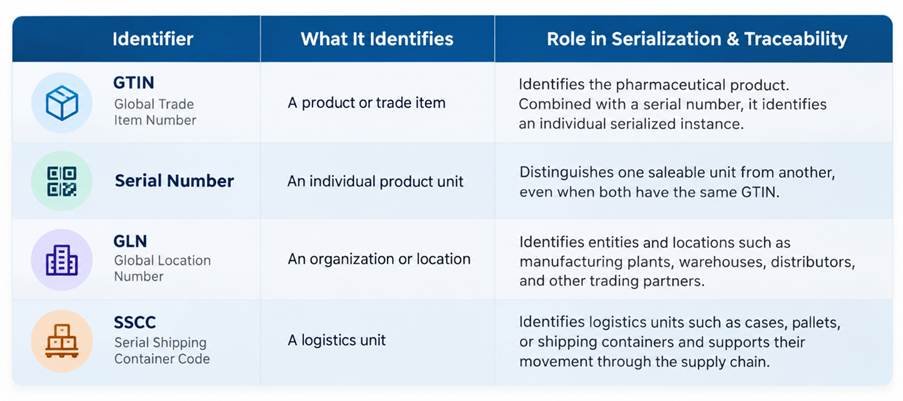
Together, these identifiers create a standardized framework for connecting products, individual units, locations, and logistics movements. When combined with event data, they provide the foundation for end-to-end pharmaceutical traceability.
Serialization as a Source of Product Intelligence
Serialization generates product and event data. Its value increases significantly when that information relates to enterprise systems such as ERP, MES, WMS, quality management, distribution, returns, and regulatory platforms.
For example, a returned product can be evaluated using its serial number, lot, expiration date, shipment history, and previous supply-chain events. Reviewing these details together can help determine the product’s status and support the appropriate disposition decision.
The same data can support inventory reconciliation, exception management, supply-chain investigations, and operational analytics.
This is where serialization moves from a compliance record to actionable product intelligence.
Supporting Recalls and Supply-Chain Investigations
When a quality or supply-chain issue affects a specific product or lot, companies can use serialized and batch-level information to identify potentially affected products and understand their distribution history.
This can support more targeted recall activities and provide greater visibility into where affected products may have moved.
The same product history can help teams investigate discrepancies during shipping, receiving, inventory reconciliation, returns, and other supply-chain processes. Connecting product identity with event history provides a more structured basis for investigating exceptions and making operational decisions.
The Role of a Pharmaceutical Serialization Consultant
Successful serialization requires more than implementing software. It means aligning regulatory requirements, business processes, master data, system integration, testing, and validation.
A pharmaceutical serialization consultant can support requirements analysis, solution configuration, integration with packaging lines and enterprise systems, serialization and aggregation testing, validation, exception management, and trading-partner connectivity.
The objective is for serialization to operate as part of the broader pharmaceutical technology ecosystem rather than as an isolated compliance system. Achieving this requires accurate data, clear processes, sound integration, and reliable event management.
Conclusion
Pharmaceutical serialization provides the foundation for identifying individual products and tracing them through complex supply chains. Combined with aggregation, standardized identifiers, GS1 EPCIS event data, and enterprise integration, it provides greater visibility across the product lifecycle.
By turning serialized data into actionable intelligence, pharmaceutical companies can strengthen traceability, support targeted recalls, improve investigations, enhance inventory visibility, and make better-informed supply-chain decisions.

Add a Comment