

Enterprise automation is entering a defining phase. Organizations are no longer asking how to eliminate manual effort — they are asking how to scale intelligence without compromising governance. As ERP environments grow more complex and AI adoption accelerates, automation architecture must evolve from isolated task execution to integrated, decision-driven ecosystems.
The debate around RPA vs Agentic AI is not about choosing one over the other. It is about designing an enterprise automation strategy that aligns structured execution with contextual reasoning. In ERP ecosystems such as SAP S/4HANA, businesses must determine how secure transaction processing, AI-driven insights, and compliance frameworks operate together at scale.
The future of enterprise automation lies in a hybrid model — where Agentic AI enhances decision-making and RPA ensures governed, system-level execution. Organizations that architect this integration correctly will unlock scalable enterprise AI automation, stronger risk control, and long-term operational resilience.
What Is RPA in Enterprise Automation?
Robotic Process Automation (RPA) focuses on automating rule-based, repetitive tasks across structured enterprise systems. It interacts with ERP, CRM, and legacy platforms to execute transactions with speed and precision.
RPA is mainly used to handle repetitive, rule-based tasks in business operations. It helps automate invoice processing and accounts payable, making transactions faster and more accurate. Companies also use it for creating purchase orders, reconciling data between systems, managing payroll processes, and transferring data from one system to another. By automating these routine activities, RPA reduces manual work and improves overall efficiency.
In SAP environments, RPA ensures high transactional accuracy while maintaining audit trails and compliance documentation. Its reliability makes it foundational to enterprise automation strategy.
However, RPA operates within predefined logic. When processes involve variability, exception handling, or contextual interpretation, rule-based execution alone becomes limited.
What Is Agentic AI in Enterprise Systems?
Agentic AI introduces contextual reasoning into automation workflows. Instead of following fixed scripts, it analyzes patterns, evaluates scenarios, and determines next-best actions aligned with business objectives.
Within SAP ecosystems, AI capabilities embedded in platforms such as SAP Joule illustrate how intelligence is being layered directly into enterprise processes.
Agentic AI enhances enterprise automation by going beyond routine task execution. It improves exception handling by identifying unusual scenarios and responding intelligently without constant human intervention. It supports risk-based decision-making by analysing context, patterns, and potential outcomes before acting. Agentic AI also enables adaptive workflow optimization, allowing processes to adjust dynamically based on real-time data. In ERP environments, it powers AI-driven automation that can interpret business intent, make informed decisions, and continuously improve performance.
Yet it does not independently execute secure system-level transactions. That capability remains within structured automation layers.
RPA vs Agentic AI: Key Differences
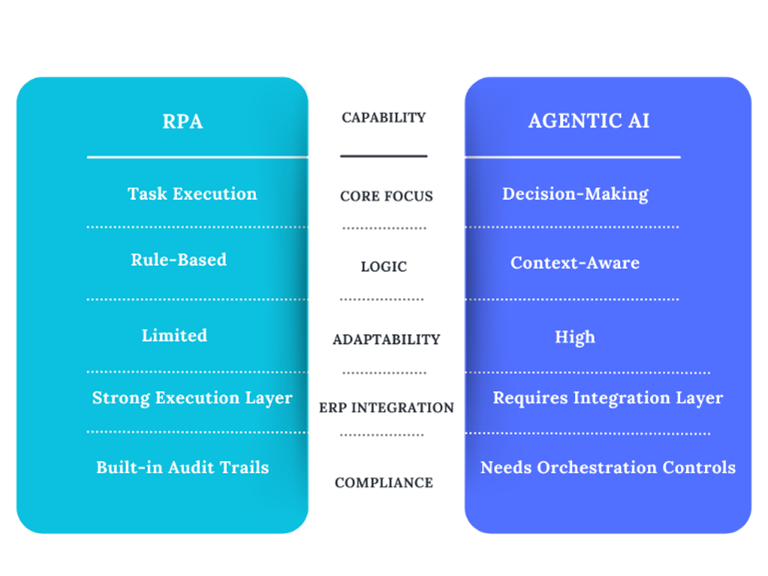
For enterprise leaders, this distinction is architectural. RPA stabilizes and governs execution across ERP systems, while Agentic AI enhances responsiveness and strategic alignment. The most resilient strategies treat these as complementary layers within a unified automation framework.
Enterprise Automation Architecture
Sustainable automation in 2026 is defined by layered architecture. Enterprises must move beyond isolated tools and build ecosystems that align intelligence, execution, and governance.
A mature automation architecture integrates:
- AI reasoning engines
- Workflow orchestration frameworks
- Secure RPA execution layers
- ERP-native compliance controls
This structure prevents fragmentation and ensures scalability while preserving governance integrity.
Consider a finance close scenario in SAP. An anomaly is detected in a high-value transaction. Agentic AI evaluates historical patterns, flags contextual risk, and recommends an adjusted approval path. Workflow orchestration enforces compliance checkpoints. RPA executes the validated transaction within ERP while maintaining audit logs.
This layered model reflects the future of enterprise automation — intelligent reasoning supported by controlled execution.
Is Agentic AI Replacing RPA?
The idea that Agentic AI will replace RPA oversimplifies enterprise realities. Large organizations operate under strict governance frameworks that require:
- Role-based access controls
- Approval hierarchies
- Segregation of duties
- Audit-ready transaction traceability
Agentic AI can recommend optimized actions and dynamically adjust workflows. However, enterprise systems demand controlled execution infrastructure capable of securely interacting with ERP platforms.
RPA remains the execution backbone of enterprise automation. The evolution of RPA vs Agentic AI is complementary — not competitive.
Why Enterprises Are Integrating RPA and AI
Modern automation strategies are shifting toward integrated RPA and AI frameworks rather than standalone deployments. Enterprises recognize that automation must combine intelligent decision-making with structured execution to scale effectively.
According to McKinsey & Company, generative AI could generate between $2.6 trillion and $4.4 trillion in annual global economic value. However, capturing that value in enterprise environments depends on governance, secure integrations, and ERP-aligned execution — not intelligence alone.
A strong hybrid model begins with governance fundamentals: role-based access control, defined approval hierarchies, segregation of duties, and transaction traceability.
The architecture typically includes:
- An AI-driven decision layer interpreting context
- A workflow orchestration layer managing compliance and dependencies
- An RPA execution layer performing secure system-level transactions
This layered structure ensures decisions are intelligent while execution remains controlled and auditable.
Organizations adopting hybrid automation strategies report broader automation coverage, reduced exception handling costs, improved compliance visibility, and stronger operational resilience. The result is not just smarter automation — but automation that is intelligent, secure, and enterprise-ready.
The Role of RPA in 2026 and Beyond
Despite rapid AI advancement, RPA remains critical. ERP environments require secure integrations, stable transaction processing, and regulatory consistency.
RPA provides the infrastructure that enables AI-powered ERP automation to function safely at scale. Without it, AI-driven insights cannot be translated into governed operational outcomes.
Its role is evolving from simple task automation to becoming the structured execution layer that supports intelligent enterprise frameworks.
The Future of RPA vs Agentic AI
The discussion around RPA vs Agentic AI reflects a broader shift in enterprise automation maturity. Sustainable digital transformation depends on integrating structured execution with contextual intelligence.
Organizations that align RPA and AI within a unified strategy achieve:
- Scalable enterprise AI automation
- Higher ROI on automation investments
- Improved governance and risk control
- Long-term operational resilience
As enterprises move toward 2026, competitive advantage will not come from isolated automation deployments. It will come from architecting intelligent ecosystems where RPA ensures precision and compliance, while Agentic AI drives adaptive decision-making and continuous optimization. The focus is shifting from tool selection to strategic orchestration — building governance-led, AI-augmented automation frameworks that evolve with business complexity and deliver measurable enterprise value at scale.
Add a Comment