
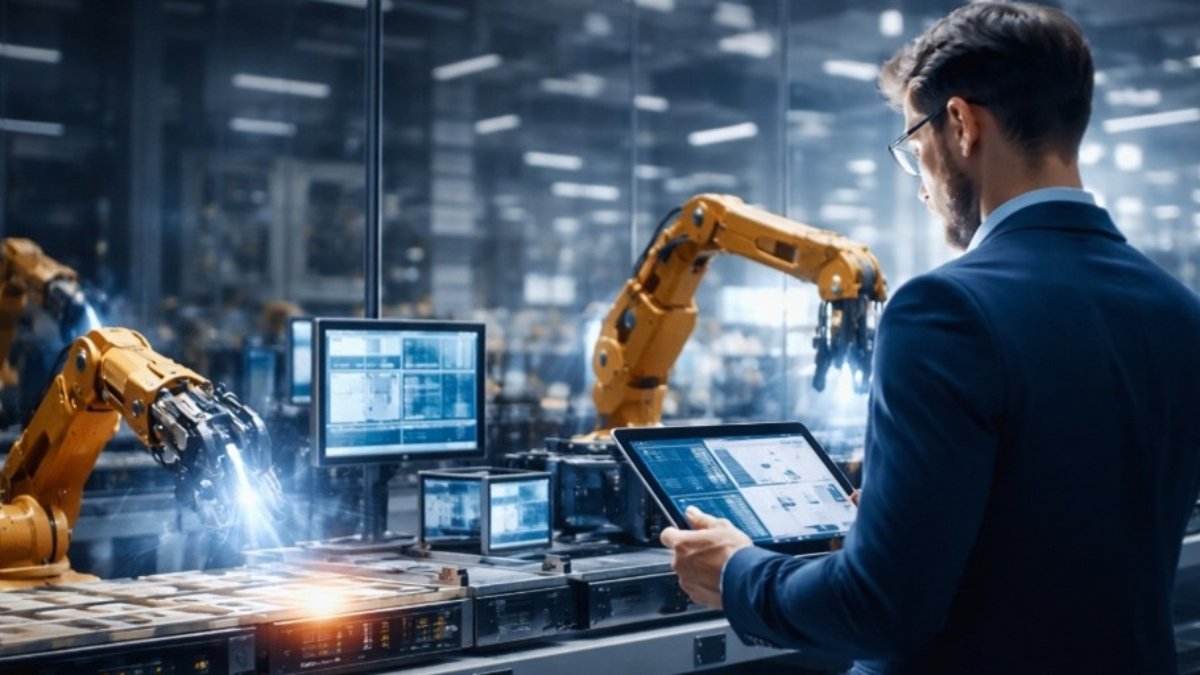
Enabling Intelligent Manufacturing Operations
Manufacturing organizations are rapidly moving beyond basic automation toward intelligent, insight-driven operations. As production environments become increasingly connected and data-rich, ERP systems are no longer expected to simply record transactions. They are now required to anticipate disruptions, optimize outcomes, and guide decision-making in real time.
At the centre of this transformation is AI and predictive technologies in SAP S/4HANA, which act as the digital core for modern manufacturing. By embedding intelligence across the SAP ecosystem, SAP S/4HANA enables manufacturers to transition from reactive execution to predictive, resilient, and scalable operations.
SAP S/4HANA as the Digital Core for Manufacturing Intelligence
SAP S/4HANA orchestrates end-to-end manufacturing processes across production planning, asset management, quality management, and supply chain execution. Its in-memory architecture enables real-time processing of operational data generated from machines, production orders, inspections, and logistics movements.
This real-time, contextualized data foundation is what makes advanced analytics and AI viable at scale. Rather than relying on fragmented datasets or batch-based reporting, manufacturers can apply predictive models directly to trusted operational data—without compromising transactional stability or system performance.
From Reactive to Predictive Manufacturing Operations
Traditional manufacturing operations are largely reactive. Maintenance occurs after breakdowns, quality issues are detected after production, and planning adjustments happen only once disruptions are visible. AI and predictive technologies change this model fundamentally.
By learning from historical patterns and continuously analyzing live operational signals, predictive systems help manufacturers anticipate issues before they escalate. This shift enables proactive interventions that protect throughput, quality, and service commitments.
Predictive Maintenance and Asset Performance Management
One of the most mature applications of AI in manufacturing is predictive maintenance. By analyzing sensor data, maintenance records, and operating conditions captured within SAP S/4HANA, AI models can identify early indicators of equipment degradation.
Instead of relying on time-based maintenance schedules, organizations move toward condition-based strategies where servicing is aligned with actual asset health. This approach reduces unplanned downtime, improves maintenance planning accuracy, and extends asset life—while ensuring production priorities remain intact.
AI-Driven Demand Forecasting and Scenario Planning with SAP IBP
Demand volatility, supply constraints, and shifting customer behavior have made traditional planning methods insufficient. SAP Integrated Business Planning addresses this challenge by embedding AI-driven forecasting and scenario planning capabilities on top of SAP S/4HANA data.
Using time-series analysis, regression models, and deep learning, SAP IBP continuously refines demand forecasts as new data becomes available. Manufacturers have reported up to 95% forecast accuracy over a 30-day horizon, including large-scale logistics optimization programs such as those executed by ASR Group.
Beyond forecasting, IBP enables planners to run what-if simulations that assess the impact of demand spikes, supply disruptions, or capacity constraints. These scenarios often incorporate POS data, sentiment indicators, and market signals to dynamically adjust replenishment and production strategies. The result is measurable business impact, including 10–30% inventory reduction and 15–25% improvements in production efficiency.
Proactive Quality Management Through Predictive Analytics
Quality management is also undergoing a fundamental shift. Rather than relying solely on post-production inspections, manufacturers are using AI to predict quality deviations during the production process itself.
By analysing production parameters, inspection results, and deviation trends, predictive models identify the conditions most likely to result in defects. This allows teams to intervene earlier, reduce scrap and rework, and standardize quality practices across plants—supporting long-term continuous improvement.
Embedded Intelligence with SAP Business AI and SAP Joule
SAP Business AI brings intelligence directly into SAP S/4HANA manufacturing workflows. Operational metrics such as equipment effectiveness, throughput, downtime drivers, and capacity utilization are analyzed continuously and surfaced contextually within business processes.
To further simplify access to insights, SAP Joule enables natural-language interaction with SAP data. This reduces dependence on static dashboards and manual reports, allowing users across roles to ask questions and receive actionable insights in real time.
Scalable Architecture and Governance with SAP BTP
As AI adoption scales, manufacturers must ensure governance, security, and architectural consistency. SAP Business Technology Platform enables organizations to deploy AI models, analytics services, and predictive applications outside the SAP S/4HANA core while preserving clean-core principles.
This approach supports centralized governance of KPIs and models, secure data access, and consistent decision logic across global manufacturing networks—without limiting innovation.
Strategic Value for Manufacturing Organizations
When AI and predictive technologies are tightly integrated with SAP S/4HANA, manufacturers gain the ability to operate with greater foresight and confidence. The combined impact includes improved planning accuracy, reduced operational risk, earlier detection of quality issues, and faster decision-making at scale.
For a broader perspective on how AI and ML enhance core ERP processes beyond manufacturing, explore how AI and machine learning transform SAP S/4HANA operations.
Conclusion: From ERP System to Intelligent Manufacturing Platform
AI and predictive technologies transform SAP S/4HANA from a transactional ERP into an intelligent manufacturing platform. By embedding prediction, simulation, and decision intelligence into core manufacturing processes, organizations gain the agility required to manage uncertainty, complexity, and growth.
For manufacturers looking to future-proof operations, SAP S/4HANA—supported by AI, predictive analytics, and SAP IBP—provides a resilient and scalable foundation for intelligent manufacturing.
Add a Comment